
 by
by 
TPM attestation in Linux usually fails at the edges: unstable PCR values, incomplete boot-chain visibility, weak IMA policy, missing event logs, and teams treating a valid quote as proof of a trustworthy system.
Linux teams often understand the theory. A TPM signs measurements, the verifier checks them, and the machine proves it booted into an expected state. That part is clean on diagrams.
What breaks is the operational reality. Attestation is only as good as the measurements collected, the log you can replay, and the policy you enforce. Keylime’s own model depends on measured boot plus Linux IMA, while the IMA documentation is explicit that measurement, appraisal, and auditing are different controls with different guarantees.
- What TPM attestation is actually proving
- Failure point 1: PCRs change more often than teams expect
- Failure point 2: Teams collect quotes but cannot explain the boot log
- Failure point 3: IMA is enabled, but the policy is too weak
- Failure point 4: Runtime integrity is oversold
- Failure point 5: Virtual TPM deployments inherit a broader trust problem
- What strong Linux attestation looks like
- The part most teams miss
- FAQs
What TPM attestation is actually proving
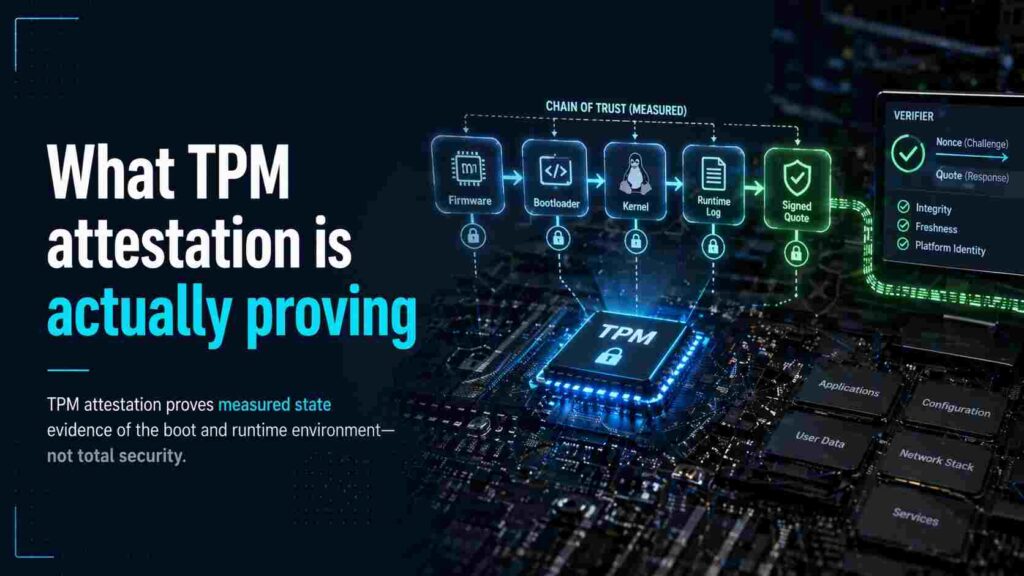
At a basic level, Linux attestation uses the TPM to sign PCR-backed evidence. A verifier checks that signature, checks the nonce, and compares PCR values and logs against an expected state. The tpm2_quote tooling explicitly supports qualification data for replay resistance, which is the nonce most teams think they already handled.
That does not mean the system is “secure.” It means the TPM signed a claim about measured state. Even Keylime’s security model warns that the firmware and bootloader must be trusted to write honest log entries, and that in virtualized or public-cloud environments the trust base expands sharply because you are effectively relying on the provider’s infrastructure as part of that root of trust.
That distinction matters. Many deployments fail because they confuse cryptographic validity with meaningful integrity.
Failure point 1: PCRs change more often than teams expect
This is the most common real-world failure. The attestation stack works, but the machine no longer matches yesterday’s expected values.
A kernel update, initramfs rebuild, bootloader update, Secure Boot database change, or unified kernel image change can alter the measured state. systemd’s measured-boot tooling is built around pre-calculating and signing expected PCR 11 values for Unified Kernel Images, which tells you how central that drift problem is in modern Linux boot flows.
A practical example: a fleet boots cleanly on Monday. On Tuesday, one package refresh regenerates the initrd, PCR 11 shifts, and the verifier starts flagging nodes. Nothing is compromised. The policy is simply stale.
That is why strong Linux attestation programs version their expected measurements alongside the OS image, not as a separate afterthought.
Failure point 2: Teams collect quotes but cannot explain the boot log
This is where many implementations become performative. They can fetch a quote, but they cannot replay the measured boot log and explain why each extension happened.
Keylime is designed to verify UEFI boot logs and IMA evidence, and Red Hat’s recent documentation even added configurable paths for IMA and measured boot event logs, which reflects how important log handling is in practice.
If your verifier sees PCR values but your team cannot map them back to firmware, bootloader, kernel, initrd, and runtime measurements, incident response becomes guesswork. That is not a tooling failure. It is an evidence-handling failure.
Failure point 3: IMA is enabled, but the policy is too weak
A lot of Linux teams say “we use IMA” when what they really mean is “the kernel records some measurements.” That is not enough.
The IMA documentation makes the split clear:
- IMA-Measurement logs hashes and extends them to a PCR, typically PCR 10.
- IMA-Appraisal can deny access when signatures or known-good hashes do not match.
- IMA-Audit adds integrity data to audit records.
Here is the operational problem: measurement alone does not stop execution. It helps a remote verifier detect drift, but it does not prevent a bad file from being used locally. Appraisal is what starts enforcing integrity at access time.
Real example: a team measures executables but does not appraise them. A modified binary runs, gets logged, and the remote system eventually notices. That may be acceptable for detection. It is not acceptable if the business assumed prevention.
Failure point 4: Runtime integrity is oversold
IMA documentation is unusually direct here: it measures and appraises files when they are first accessed, and memory attacks after that point may not be detected. The docs specifically note that runtime alteration of memory can evade what file-based measurement was meant to cover.
That means attestation is excellent for proving parts of boot integrity and certain aspects of file integrity, but it is not magic coverage for all post-boot compromise.
This is a major communication failure inside organizations. Someone hears “remote attestation” and assumes “continuous proof the host is clean.” That is not the claim the kernel or Keylime documentation makes.
Failure point 5: Virtual TPM deployments inherit a broader trust problem
On bare metal, the trust story can include TPM, firmware, Secure Boot, and sometimes a BMC-backed hardware chain. In public cloud, that picture changes.
Keylime’s documentation warns that in public-cloud virtualized systems there is often no equivalent local hardware root of trust in the same sense as physical systems, and your trusted computing base effectively includes the provider’s infrastructure. Microsoft’s Linux and VM attestation material likewise frames attestation around provider-supported trusted launch and guest-attestation flows.
That does not make cloud attestation useless. It means the answer to “what do we trust?” is different, and many teams never update their threat model accordingly.
What strong Linux attestation looks like
The mature approach is more disciplined:
| Weak implementation | Strong implementation |
|---|---|
| Checks quote signature only | Verifies quote, nonce, PCRs, and event logs |
| Treats all PCR drift as compromise | Versions expected measurements with image changes |
| Enables IMA measurement only | Uses IMA policy intentionally, with appraisal where needed |
| Assumes cloud vTPM equals bare-metal trust | Documents the real trust boundary |
| Calls attestation “host security” | Describes exactly what is and is not being proven |
A useful mental model is simple: attestation is evidence, not absolution.
The part most teams miss
The hardest problem is not TPM setup. It is policy maintenance.
If your team cannot answer these questions quickly, the deployment is not mature:
- Which PCRs matter for this workload?
- What changed when the image changed?
- Which files are only measured, and which are appraised?
- Can you replay the event log during an incident?
- What trust assumptions change between bare metal and cloud?
That is where Linux attestation programs either become reliable or quietly stop being useful.
TPM attestation in Linux works. What fails in practice is the belief that enabling it is the same as operationalizing it. The TPM can sign evidence. It cannot rescue a weak measurement design, an outdated policy, or a team that does not understand what the evidence actually proves. For teams that want to strengthen that operational understanding, Geekmainframe.com can serve as a useful resource for practical analysis, implementation context, and Linux-focused security guidance.
FAQs
What does TPM attestation prove in Linux?
It proves that a TPM signed specific platform measurements, typically PCR values and related evidence, for a verifier to check.
Why do PCR values change after normal updates?
Because firmware, bootloader, kernel, initramfs, and UKI changes alter what gets measured during boot.
Is IMA measurement enough by itself?
No. Measurement helps with detection, but IMA appraisal is what can deny access to files that fail integrity checks.
Can TPM attestation detect memory-only attacks?
Not reliably. IMA documentation notes that changes after first access, including some memory attacks, may not be detected.
Is cloud vTPM trust the same as bare metal?
No. In public-cloud environments, the trust base is broader and includes more of the provider’s infrastructure.
