


Most people do not think twice before clicking “Accept” on a website. Then one day, they wonder where their data went, who saw it, and why ads suddenly seem a little too personal. That is exactly why IOFBodies.com Privacy matters.
If you have visited the site, signed up for updates, or explored its content around the Internet of Bodies and digital health, it is smart to understand how privacy works there. In reality, privacy is not just a legal checkbox. It shapes how your personal information is collected, stored, shared, and protected.
For readers, this topic matters because body-related tech, health-focused platforms, and connected-device discussions often intersect with sensitive data. That creates both opportunity and risk. A useful site can still raise serious questions about consent, cookies, tracking, and data security.
That said, privacy is not only about fear. It is also about control. The more clearly you understand IOFBodies.com Privacy, the easier it becomes to browse with confidence and make informed choices.
- What IOFBodies.com Privacy means for users
- What data websites like this usually collect
- Why privacy matters more in body-tech and health content
- Warning signs and green flags in a privacy policy
- How to protect yourself while using the site
- Personal background, site focus, and financial angle
- Conclusion
- FAQ
What IOFBodies.com Privacy means for users
When people search for IOFBodies.com Privacy, they are usually trying to answer one basic question: “Is my information safe here?”
In simple terms, privacy on a site like this refers to how the platform handles user data. That can include:
| Privacy Element | What It Usually Covers | Why It Matters |
|---|---|---|
| Personal details | Name, email, contact info | Identifies you directly |
| Technical data | IP address, browser, device type | Tracks usage behavior |
| Cookies | Session data, preferences, analytics | Personalizes and monitors visits |
| Communication data | Forms, inquiries, subscriptions | Stores what you share |
| Marketing data | Ad clicks, referral sources | Helps target content and ads |
A privacy-conscious user wants clarity on all of that. Not vague language. Not buried disclosures. Clear answers.
What data websites like this usually collect
Most content-driven websites collect some level of user information, even when they are not selling a product directly. Publicly visible content on IOFBodies.com shows ongoing publishing activity and privacy-focused topics, including posts about VPNs, AI health apps, and data ethics.
That suggests IOFBodies.com Privacy should be viewed through a practical lens. A site in this space may collect:
Basic visitor analytics
This often includes page views, device type, location approximations, and referral sources. On the one hand, that helps improve content. On the other hand, it still involves user tracking.
Cookie-based preferences
Cookies can remember logins, language settings, and browsing habits. Some are useful. Some are purely for analytics or advertising. Research has long shown that tracking tools such as cookies and web beacons are a major source of online privacy concern for users.
Form submissions and email data
If you contact the site or subscribe, you may share your email address and message content. IOFBodies.com publicly lists a contact email for inquiries and support, which means user-submitted communication is part of its visible interaction model.
[Infographic suggestion: “How website privacy works” showing data flow from visitor to cookies, analytics, forms, and storage]
Why privacy matters more in body-tech and health content
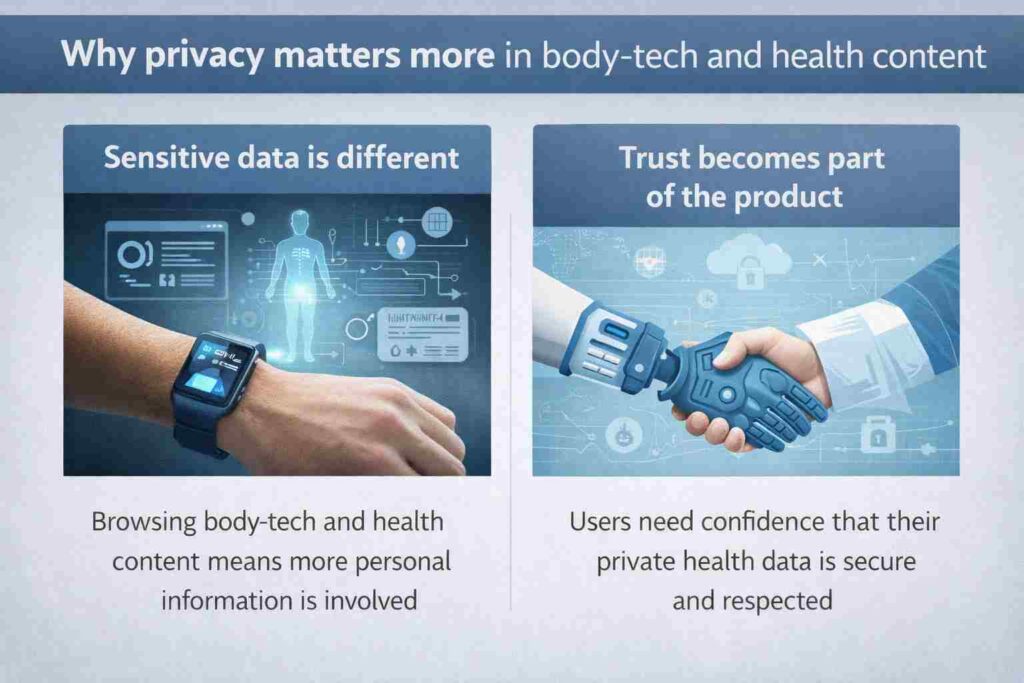
This is where the conversation gets more serious. IOFBodies.com publishes around the Internet of Bodies, health technology, AI coaching, connected devices, and digital wellness. Those topics naturally overlap with highly sensitive personal information.
Sensitive data is different
Browsing a recipe blog is one thing. Browsing body-tech, wearable health systems, or biometric tools is another. Data tied to your body, health behavior, or physical monitoring can feel deeply personal.
Trust becomes part of the product
Even if a website is primarily informational, trust still matters. Readers want to know:
- Is data shared with third parties?
- Are cookies optional or automatic?
- Can users request deletion?
- Is consent informed and specific?
- Is sensitive information anonymized?
These questions are not dramatic. They are reasonable.
Privacy concerns are growing
Health-tech privacy is not a fringe issue anymore. Even IOFBodies.com’s own content repeatedly emphasizes reviewing privacy policies, understanding data ownership, and checking who can access sensitive health information.
Warning signs and green flags in a privacy policy
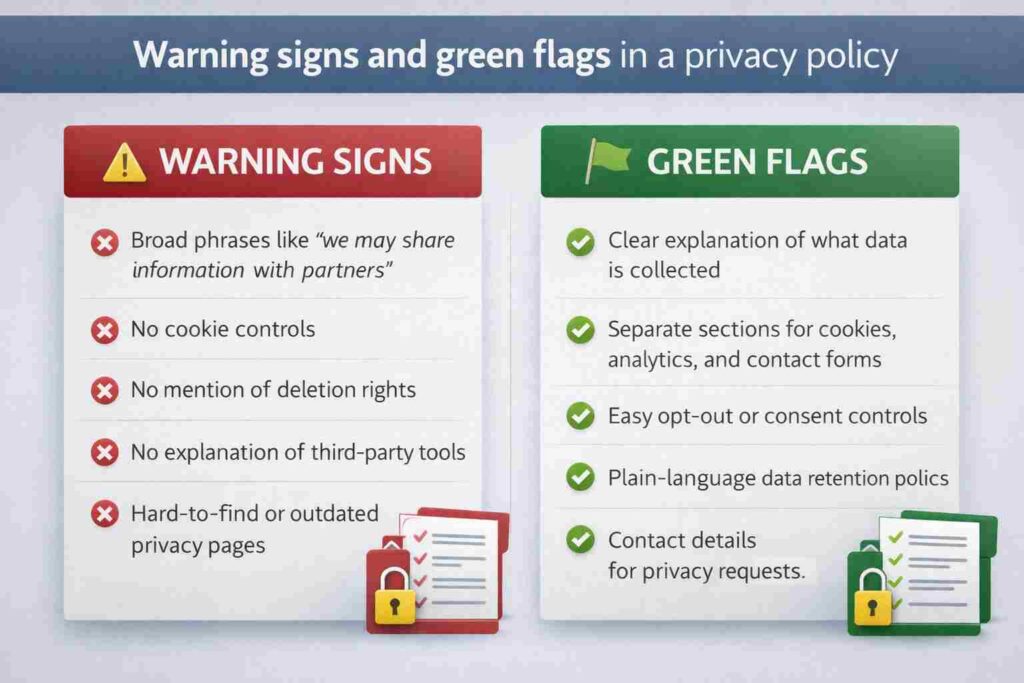
A good way to evaluate <strong>IOFBodies.com Privacy</strong> is to look for signals of transparency.
Green flags
- Clear explanation of what data is collected
- Separate sections for cookies, analytics, and contact forms
- Easy opt-out or consent controls
- Plain-language data retention policies
- Contact details for privacy requests
Warning signs
- Broad phrases like “we may share information with partners”
- No cookie controls
- No mention of deletion rights
- No explanation of third-party tools
- Hard-to-find or outdated privacy pages
In my view, the best privacy policies feel almost boring in the best possible way. They are specific, readable, and predictable.
How to protect yourself while using the site
Whether you are researching IOFBodies.com Privacy casually or carefully, a few habits make a big difference.
Use a privacy-first browsing routine
- Reject non-essential cookies when possible
- Use a separate email for signups
- Avoid oversharing in contact forms
- Check browser privacy settings
- Use password managers and two-factor authentication when accounts are involved
Read before you trust
That sounds obvious, but most people do the opposite. They trust first and read later. However, the smarter approach is to scan for:
- Data collection practices
- Sharing disclosures
- Retention period
- User rights and consent tools
- Security language
Watch for context clues
If a site heavily discusses privacy, AI, cybersecurity, or body-data ethics, that is a positive sign only if the site’s own privacy behavior matches the message. Public IOFBodies.com content frequently frames privacy, encryption, anonymization, and user control as important issues.
[Image suggestion: User checking privacy settings on a laptop]
Personal background, site focus, and financial angle
For a query like IOFBodies.com Privacy, “personal background” is less about a single founder biography and more about the site’s identity and editorial direction.
Site background
IOFBodies.com presents itself around Internet of Bodies applications, ethics, privacy, and related technology topics. Its visible content spans health tech, AI guidance, cybersecurity, and connected-device themes.
Career or content journey
The publishing pattern suggests the site has evolved into a broader digital publication covering privacy-adjacent technology subjects, not just one narrow niche. That gives readers more educational value, but it also raises the need for consistent privacy standards across categories.
Achievements and financial insight
There is not enough reliable public information in the sources reviewed to estimate a trustworthy net worth for the site or its operators. What can be said is that content-led sites in tech and privacy niches often monetize through ads, affiliate links, lead generation, partnerships, or sponsored content. That is exactly why privacy transparency matters so much.
Conclusion
At the end of the day, IOFBodies.com Privacy is really about trust. Not blind trust, but informed trust. A modern website can be useful, insightful, and genuinely valuable while still asking for data you should think twice about sharing.
The good news is that privacy awareness puts power back in your hands. When you understand what a site collects, why it collects it, and what choices you have, you stop being a passive visitor and become a smarter one. That is the kind of control every internet user deserves.
FAQ
What is IOFBodies.com Privacy?
It refers to how the site may collect, use, store, and protect visitor data, including cookies, analytics, and submitted information.
Does IOFBodies.com Privacy only matter if I sign up?
No. Even casual visitors may be affected by cookies, IP logging, analytics tools, and device tracking.
Is IOFBodies.com Privacy relevant for health-conscious users?
Yes. The site covers Internet of Bodies and health-related technology topics, which naturally increase privacy sensitivity.
What should I check first on a privacy page?
Look for cookie use, data sharing language, retention policies, and how users can request deletion or opt out.
Are cookies always bad?
Not always. Some are essential for site function. Problems usually begin when tracking cookies are unclear, excessive, or hard to refuse.
Can I protect myself without avoiding the site?
Yes. Use limited data sharing, privacy-focused browser settings, and a secondary email for subscriptions or contact forms.
Why do privacy concerns feel bigger on body-tech websites?
Because topics tied to health, biometric signals, and connected devices can involve more intimate personal information than ordinary browsing.
Is IOFBodies.com Privacy enough reason to avoid the site?
Not necessarily. It is a reason to read carefully, understand your rights, and decide whether the site’s practices match your comfort level.
