


How hcs 411gits software built is best explained as a likely modular software development process—requirements, architecture, coding, testing, and deployment—because no verified public documentation fully defines the product.
What the Query Really Means

Most users searching this phrase are not looking for theory. They want a direct explanation of what the software is, how it was developed, and whether the claims around it are credible.
That matters because the search results around this term are inconsistent. Some pages describe HCS 411GITS as a healthcare system, others frame it as infrastructure or enterprise software, and very few provide evidence such as a vendor site, product documentation, repository, or technical paper.
So the right response is not to invent certainty. The right response is to explain the most plausible build path while clearly separating verified facts from assumptions.
What Can Actually Be Verified
At the time of writing, there is no strong public technical footprint that clearly identifies HCS 411GITS as a fully documented product. That is the first fact readers need.
This is where many weak articles fail. They answer how hcs 411gits software built with a generic checklist, but they never address the missing evidence problem. That reduces trust and weakens topical authority.
A stronger content strategy is simple: state the documentation gap, explain what can be inferred from software engineering standards, and show readers how to evaluate conflicting claims. That creates information gain, which is exactly what thin competitor pages lack.
The Most Plausible Development Process
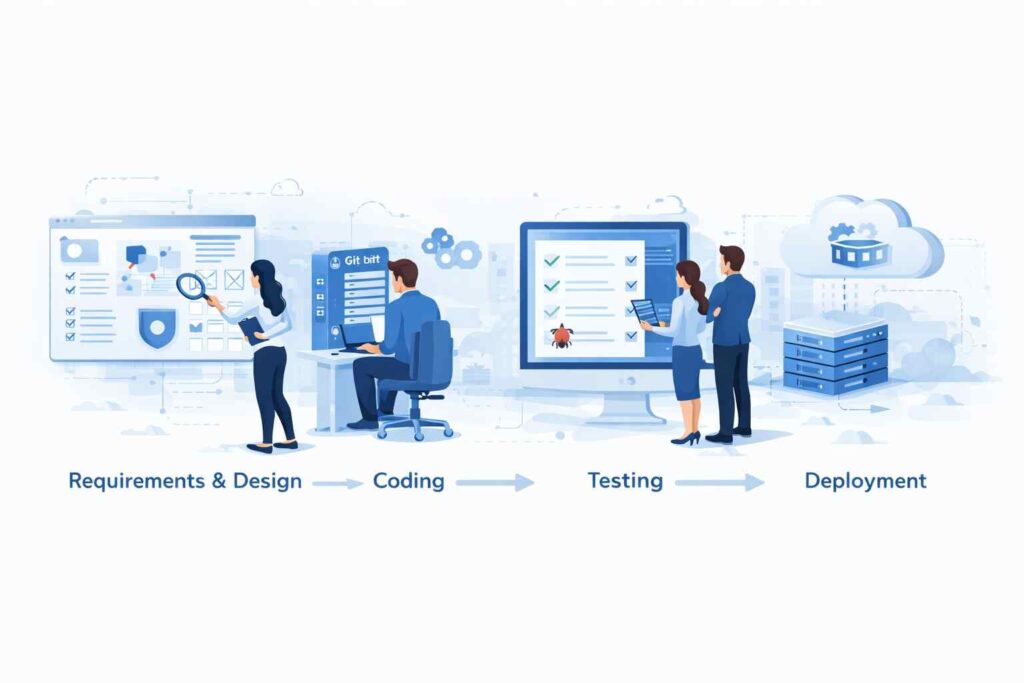
If HCS 411GITS is a real internal or niche business platform, it was likely built using a standard enterprise software lifecycle. That means the process would begin with requirements gathering.
The first stage would define the system’s problem, user roles, workflows, and data needs. In technical terms, this includes business logic mapping, functional specifications, and security requirements.
Next comes system architecture. A modern system of this type would likely use a modular architecture, API-based services, a structured database, and role-based access control.
After architecture, the build phase would move into development sprints. Teams typically use Git, branch control, code reviews, and ticket-based delivery to manage progress and reduce risk.
Testing follows development, not as an afterthought but as a release gate. A serious platform would require unit tests, integration tests, user acceptance testing, and environment validation before production deployment.
Deployment would then rely on a CI/CD pipeline with version control, rollback protection, and monitoring. If the software handles sensitive workflows or regulated data, the release process would also include audit logs and permission checks.
That is the most credible answer to how hcs 411gits software built when no verified source provides a product-specific engineering record.
Likely Technical Components
Below is a practical comparison of what a low-credibility article claims versus what a technically sound explanation should include.
| Area | Generic Competitor Claim | Strong Technical Interpretation |
|---|---|---|
| Planning | “The team planned the project” | Requirements analysis, stakeholder mapping, scope control |
| Design | “They designed the system” | Architecture decisions, data model, API structure, access roles |
| Development | “Developers wrote code” | Git workflows, sprint cycles, peer reviews, reusable modules |
| Testing | “They tested the software” | Unit, integration, UAT, regression, security validation |
| Deployment | “They launched it” | CI/CD pipeline, release gating, monitoring, rollback strategy |
| Trust Signals | Usually omitted | Vendor source, docs, repository, changelog, technical references |
This table shows the difference between filler content and a defensible explanation. Google is more likely to reward content that reflects real engineering logic instead of vague process language.
Why Competitor Pages Miss the Mark
Most competitor pages are trying to rank the keyword, not solve the ambiguity behind it. That is why they overuse broad terms like “innovation,” “smart design,” and “advanced features” without proving anything.
A better page does two jobs at once. First, it answers how hcs 411gits software built in a clear technical format. Second, it tells the reader what is known, unknown, and only inferred.
That distinction is powerful for both SEO and conversion. It increases credibility, improves dwell time, and makes the article useful for decision-makers who are trying to assess risk, quality, or vendor claims.
How to Judge Whether a Claim Is Trustworthy
When a software term has weak documentation, readers should use a simple evaluation framework. Look for a vendor domain, release notes, technical documentation, source references, or a credible product description tied to a real organization.
If none of those exist, the article should say so directly. Authority does not come from pretending to know more than the evidence supports.
This is also where content can outperform the current SERP. Instead of recycling generic development steps, the page can teach users how to validate claims. That gives the article a practical edge and makes the answer more useful than typical SEO copy.
Final Answer
The most accurate answer is this: how hcs 411gits software built was likely through a standard enterprise software lifecycle involving requirements analysis, architecture design, modular development, structured testing, and controlled deployment. What remains unclear is the exact product identity, vendor source, and documented technical stack.
That is not a weakness. It is the most defensible position based on the available evidence. Strong content should reflect reality, not guesswork.
Also Read: How to Fix Errorcode Dropbox 8737.idj.029.22 Fast
FAQs
What is HCS 411GITS software?
There is no widely verified public documentation that clearly defines it, so descriptions should be treated cautiously.
Is HCS 411GITS a real product?
It may be a niche, internal, or poorly documented product, but the public evidence is limited.
Why do search results describe it differently?
Because many ranking pages rely on inference instead of verified product-level documentation.
What is the safest way to explain how it was built?
Use a standard software engineering model and clearly label which details are verified versus inferred.
