

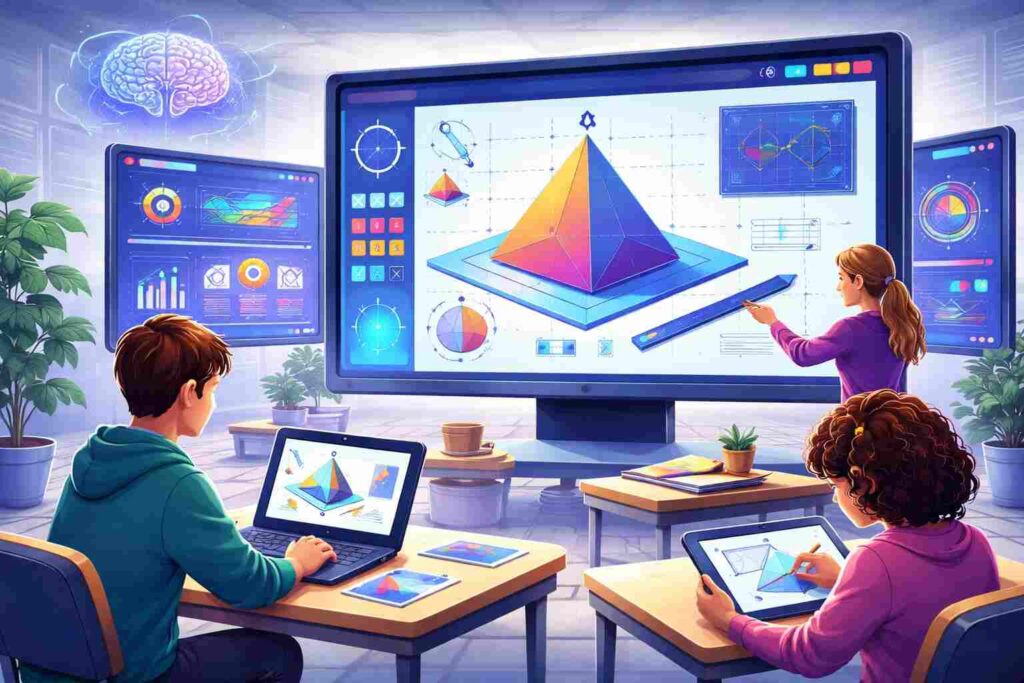
Geometry Learn V3 is redefining how students approach geometry — replacing outdated, static study methods with a dynamic, AI-enhanced experience built around real-time interaction and precision-guided practice. The official public page is simple, but it confirms an active V3 experience under “The GL Series,” including sections for Games, Apps, and Extras. Third-party coverage fills in the deeper product details, describing a platform built around visual geometry work, adaptive support, and classroom-friendly workflows. That combination makes geometry learn v3 relevant to students, teachers, and institutions looking for a practical math tech platform.
- What Is Geometry Learn V3 — The AI Engine Redefining How Students Learn Math
- Inside the AI-Enhanced Learning Engine: Features Built for Real Results
- How Artificial Intelligence Makes Complex Geometry Simple and Visual
- Adaptive Learning in Action: How V3 Personalizes Every Student’s Math Journey
- Geometry Learn V3 vs. Conventional Math Tools — The Future Wins Every Time
What Is Geometry Learn V3 — The AI Engine Redefining How Students Learn Math
Recent articles describe Geometry Learn V3 as an interactive geometry platform focused on visual learning, theorem practice, measurements, and spatial reasoning. Instead of relying only on text explanations, the platform is described as letting students manipulate shapes, test congruence, and work through guided modules. That matters because geometry is a subject where understanding often improves when learners can see relationships change in real time. The official site itself does not document a full technical stack, but the public descriptions consistently frame V3 as a structured, digital-first learning environment.
Why the “AI learning engine” label is practical
The official V3 page does not publish a technical white paper or engineering documentation, so the “AI engine” label should be treated as product positioning unless more formal documentation is released. However, multiple current write-ups describe adaptive algorithms, guided feedback, and personalized practice. In practical edtech terms, those are the core behaviors most people mean when they say “AI learning engine”: the system adjusts support and difficulty using student performance data. That is a useful distinction for accuracy, and it still supports the article’s core topic.
Inside the AI-Enhanced Learning Engine: Features Built for Real Results
Across the available coverage, Geometry Learn V3 is associated with interactive lessons, digital manipulatives, and step-by-step problem solving. Reported tools include virtual rulers, protractors, compasses, and transformation controls, plus guided exercises and built-in assessment features. These features are practical because they combine instruction and practice in one place. As a result, learners can study a concept, test it, and get feedback without switching between multiple resources. For teachers, articles also describe dashboards and progress tracking, which makes the platform more usable in real classroom settings.
Adaptive math technology and personalized learning
Adaptive learning is one of the most repeated claims in the public descriptions of Geometry Learn V3. The platform is described as adjusting challenge level based on how a student performs, with extra support for struggling learners and harder tasks for advanced learners. Additionally, the reported use of assessment and analytics tools aligns with common educational AI tools patterns, where feedback and progression are tightly connected. That makes the adaptive math technology angle practical, not just promotional, because it directly affects pacing, confidence, and mastery.
How Artificial Intelligence Makes Complex Geometry Simple and Visual
Geometry becomes difficult when diagrams are static, unclear, or disconnected from the student’s reasoning process. AI-enhanced visual support helps solve that problem by improving clarity and responsiveness. A recent research paper on geometry education and deep learning specifically notes that deep learning models can help correct drawing errors in 3D geometry visuals, which can make instructional diagrams clearer and easier to understand. That does not prove the exact internal model used by Geometry Learn V3, but it does support the educational logic behind an AI-enhanced interactive geometry platform: better visuals lead to better comprehension.
Interactive tools and AI feedback that replace traditional geometry textbooks
Traditional geometry textbooks still provide foundational definitions and proofs, but they cannot react when a learner makes a mistake. Interactive systems can. Public descriptions of Geometry Learn V3 repeatedly emphasize real-time updates, manipulation of shapes, and guided explanations, which creates a stronger feedback loop than passive reading alone. Therefore, students can test a step, see what changed, and correct their reasoning immediately. Beyond that, this workflow supports geometry problem solving in a more natural way, especially for visual learners and students who need repeated practice to build confidence.
Adaptive Learning in Action: How V3 Personalizes Every Student’s Math Journey
Geometry Learn V3 is consistently described as a personalized learning experience, and that is where the platform appears most aligned with modern educational AI tools. Articles describe targeted practice, guided pathways, and progression across topics such as transformations, measurements, and proof work. More importantly, the personalization model matches real classroom needs: one learner may need extra support on angle relationships, while another is ready for advanced coordinate geometry. In contrast, static resources usually deliver the same sequence to everyone. Adaptive support helps keep both learners moving.
Who benefits most from Geometry Learn V3 — Students, educators, and institutions
Students benefit from immediate feedback and visual interaction. Educators benefit from lesson-ready activities, assessments, and analytics that help them identify misunderstandings earlier. Institutions benefit from the reported cross-device access and integration-focused design discussed in recent coverage. The official page remains lightweight, but the broader public descriptions consistently present Geometry Learn V3 as a flexible math tech platform for classroom use, self-paced study, and blended learning.
Geometry Learn V3 vs. Conventional Math Tools — The Future Wins Every Time
The clearest difference between Geometry Learn V3 and conventional math tools is responsiveness. A worksheet can show a problem, but it cannot animate a transformation, adapt difficulty, or provide instant guided correction. Geometry Learn V3 is repeatedly described as dynamic, interactive, and adaptive, which is especially important for geometry, where visual reasoning is part of the solution process itself. Geometry Learn V3: AI Enhanced Interactive Learning Engine stands out because it combines interactive geometry platform design, personalized learning, and adaptive math technology in one workflow. For readers evaluating modern geometry learning options, geometry learn v3 is best understood as a practical, AI-leaning educational platform whose strongest public evidence is its interactive learning design and adaptive features.
Also Read: Janitor AI Secrets: Tips, Tricks and Best RP Bot Settings
